TL;DR
The UK e-Truck Charging Landscape in 2026
Who’s live, who’s coming, and what actually works for fleets
Electric trucks are no longer theoretical. They are on UK roads today, working real routes, carrying real freight. What still lags behind is the infrastructure needed to support them at scale.
Unlike cars and vans, truck charging is not about convenience. It is about certainty. Fleets need to know where they can charge, whether they can fit, whether it will work first time, and whether it fits the duty cycle. This is where the UK e-truck charging landscape starts to look very different from passenger EV charging.
This article explores the current state of truck charging in the UK, broken down by operators that are live today, those with stated ambitions, and the ecosystem quietly making it all possible. It also explains where Paua fits and why aggregation matters more for trucks than any other vehicle class.
Read more about Paua electric truck charging.
Why truck charging is fundamentally different
Before diving into networks, it is worth setting the context. Electric truck charging differs from car charging in four critical ways:
- Power: Trucks typically require 150 kW to 400 kW today, moving towards megawatt charging.
- Space: Vehicle length, height, turning radius and trailer access all matter.
- Operations: Charging must fit driving hours, loading windows and shift patterns.
- Risk: A failed charge is not an inconvenience. It is a missed delivery.
As a result, “car-first” charging infrastructure rarely works well for trucks, even when power ratings look sufficient on paper.
Live truck charging networks in the UK

Public multi-use sites with truck access
These are sites designed primarily for cars and vans but capable of accommodating trucks in specific locations. They currently form the bulk of usable public infrastructure for eHGVs.
Key operators include:
- GRIDSERVE
- Shell Recharge
- Euro Garages
- Instavolt
- Fastned
- Leap 24
These sites matter because they exist today and are accessible without prior agreements. However, they come with limitations:
- Not all sites are physically accessible to all trucks
- Availability is unpredictable
- Sites remain few and far between
- Layouts are rarely optimised for HGV manoeuvring
For early adopters, these networks are essential but imperfect.
Paua continues to add these operators to the Paua EV charge card.
Truck-only public charging
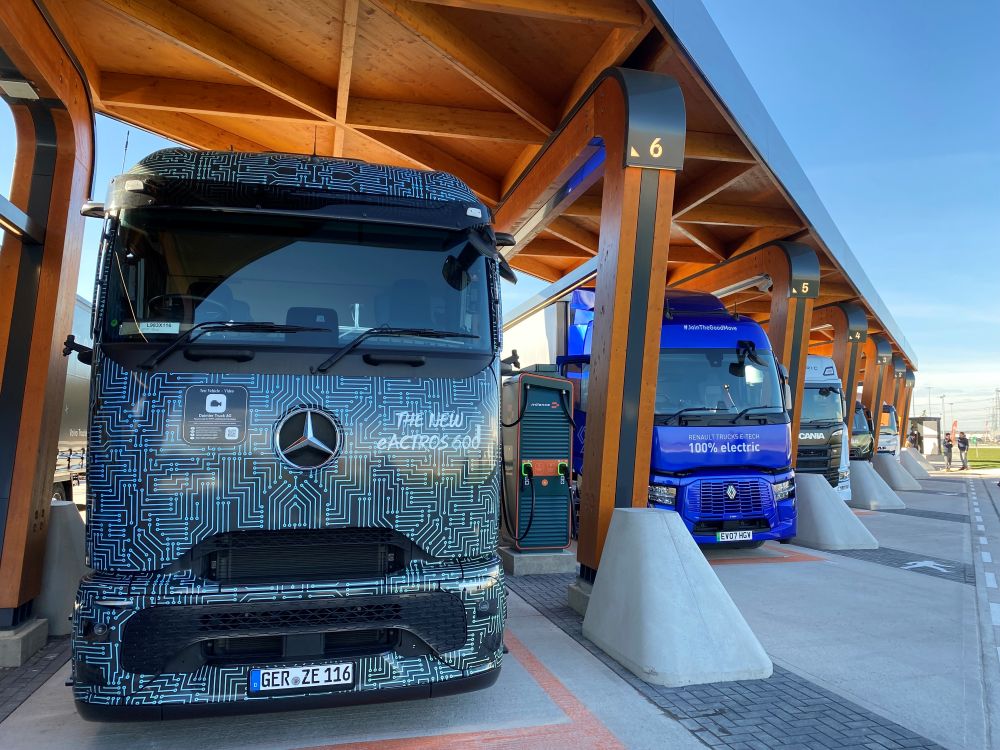
Milence is currently the only operator live in the UK with sites designed exclusively for electric trucks.
Backed by Daimler Truck, Volvo Group and Traton, Milence represents what “proper” truck charging looks like:
- Drive-through bays
- High power hardware
- Locations aligned to freight corridors
- Secured sites with gate access
The challenge is timing. Coverage is still limited and fleets cannot plan national operations around a handful of sites. Milence is critical to the future, but not yet sufficient on its own.
Paua has partnered wiht Milence to ensure it is available on the Paua EV Charge card.
Semi-private and shared access networks
This is where the market gets interesting.
A growing number of truck and bus operators are opening their private infrastructure through controlled commercial agreements rather than full public access.
Examples include:
- First Bus
- Welch’s Transport
- Zenobē
- Voltloader
- Other bus operators
- Other truck operators
- Truck dealer sites
These sites are often:
- Built for large vehicles
- Secure
- Underutilised outside core operations
They are not publicly accessible in the traditional sense, but with the right commercial and technical layer, they become usable fleet infrastructure.
This model is quietly doing more for truck electrification than most public announcements.
Paua Share enables these sites to be available via a centralised EV charge card experience.
Operators with stated truck charging ambitions
Beyond what is live today, a long list of credible players have publicly stated plans to support truck charging in the UK, either through dedicated hubs, multi-use sites, or semi-private models.
These electric truck charging playersinclude:
Aegis Energy, Relode, FleetE, AW Energy, E.On Drive, BP Pulse, Pragma Charge, Chargepoly, Octopus Energy, Ryze Energy.
Some are backed by serious capital. Others are early-stage but focused. What unites them is intent, not execution.
For fleets, this distinction matters. Announced does not mean usable. Until sites are live, interoperable and discoverable, they remain future optionality rather than operational infrastructure.
Paua will seek to aggregate these into a single EV charge card experience as they come to market.
The supporting ecosystem powering truck charging
Truck charging networks do not appear by magic. Behind every site is a complex stack of hardware, software, grid expertise and operational services.
Key ecosystem players include:
EVolt, Vital EV Solutions, Fuuse, Envevo, VEV, EO, Voltempo, Devitech, Virta, Heliox, Flexible Power Solutions, Mer, Electric Miles.
These companies:
- Design and build infrastructure
- Operate charge point management systems
- Integrate energy and flexibility services
- Enable reservation, access control and billing
For fleets, this layer is invisible but essential. Without it, even the best located site does not work reliably.
The biggest gap in the market: aggregation for trucks
Passenger EV charging has benefitted from years of aggregation. Drivers expect one app, one payment method, and visibility across networks.
Truck charging does not yet enjoy this luxury.
The reality today:
- Infrastructure is fragmented
- Access rules vary by site
- Many viable chargers are invisible to fleets
This is where aggregation becomes strategic rather than cosmetic.
Where Paua fits
Paua’s role in truck charging is not to build chargers. It is to make existing and emerging infrastructure usable at scale.
Paua does this in three key ways:
1. Aggregated access with truck-specific filtering
Fleets can see which public multi-use sites are actually suitable for trucks, not just theoretically high power. Paua's commercial vehicle filter enables the separation of small (car), medium (large van and rigid truck) and large (articulated eHGV) charging sites.
2. Enabling semi-private access through Paua Share
Paua Share allows private depots and fleet sites to be shared safely, commercially and with full control. This turns stranded private infrastructure into usable network coverage.
Details of Paua share are here.
3. Commercial-grade payments and reporting
Truck charging volumes are large. Billing, reconciliation and audit trails matter. Paua handles this in a way fleet finance teams actually trust.
The result is a network that reflects how trucks really operate, not how car charging evolved.
View the Paua Truck charging map here
Why shared depots matter more for trucks than cars
Shared depot charging is not a nice-to-have for eHGVs. It is a bridge to scale.
Benefits include:
- Faster access to suitable locations
- Lower cost per kWh
- Higher utilisation of existing assets
- Reduced reliance on scarce public truck hubs
In practice, shared depots are already enabling routes that would otherwise remain diesel-only.
What the next 3 years look like
The direction of travel is clear:
- More dedicated truck hubs will be built
- Public funding will continue to support corridors
- Fleets will increasingly mix public, semi-private and private charging
What will matter most is not who builds the most chargers, but who makes them usable together.
For truck electrification to scale, the market needs fewer silos and more connective tissue.
Final thoughts
The UK e-truck charging market is no longer hypothetical. It is live, fragmented, fast-moving and full of promise.
A small number of operators are delivering real infrastructure today. Many more are coming. The supporting ecosystem is maturing quickly.
The winners will be fleets that plan around reality, not press releases, and platforms that make complexity manageable.
Truck charging is not about plugging in. It is about keeping freight moving.
And that is exactly where Paua plays.
Paua is the EV charging payment platform for business. Paua is a business EV charging payment platform that enables fleets to manage public, home and workplace charging in one system.
Read more about Paua Truck charging here.