TL;DR
EV charging networks run on two key standards. OCPP controls the charger, OCPI connects the networks.
For CPOs, great OCPP drives reliability and great OCPI drives revenue.
Paua uses OCPI to give fleets seamless EV charging payment, roaming and access across the UK.
OCPI vs OCPP. The vital difference every CPO should understand when working with Paua
Electric vehicle charging is powered just as much by software as it is by electricity. For chargepoint operators choosing a roaming partner or EV charge card provider, understanding how the digital plumbing works is genuinely strategic. Two standards in particular crop up time and again: OCPI and OCPP. They sound similar, they both begin with “Open”, and they are often mentioned in the same breath. Yet they do completely different jobs.
For CPOs who want to integrate with Paua, operate a high performing network and keep fleets coming back, understanding the distinction will make your life much easier. This blog walks through the key concepts, the questions search engines love (;-)), and the practical implications that matter to you and your customers.
What is OCPI?
OCPI (Open Charge Point Interface) is a global protocol for roaming and interoperability between EV charging networks, multi-service providers, hubs and mobility platforms. Think of it as the language spoken between companies, not between charge points and their owners.
OCPI enables a number of critical services:
- Location data exchange so eMSPs (more on them below!) like Paua can show accurate chargepoint information
- Tariff information so drivers know what they will pay
- Authorisation requests that decide whether a charging session can begin
- Session and CDR data for billing, reconciliation and settlement
- Optional extras like reservations, tokens, smart charging signals and remote commands
OCPI is flexible, modular and designed to be future proof. For Paua, it is the cornerstone of how we provide access to the UK’s largest aggregated EV charging payment network, including public rapid chargers, depot sites through Paua Share and new eHGV charging locations.
What is OCPP?
While OCPI connects companies, OCPP connects hardware. The Open Charge Point Protocol is the standard used between a chargepoint and the CPO’s backend system. It enables:
- Remote start or stop
- Firmware updates
- Fault codes and alerts
- Live diagnostics
- Transaction management
- Local pricing updates
- Power settings and smart charging controls
If a charger sends heartbeat messages, raises an error or downloads new firmware, this is almost always happening through OCPP. It is the operational lifeline for CPOs and the foundation for network reliability.
What is the difference between OCPI and OCPP?
In one line:
- OCPP runs the charger.
OCPI runs the network.
More formally, the core differences look like this:
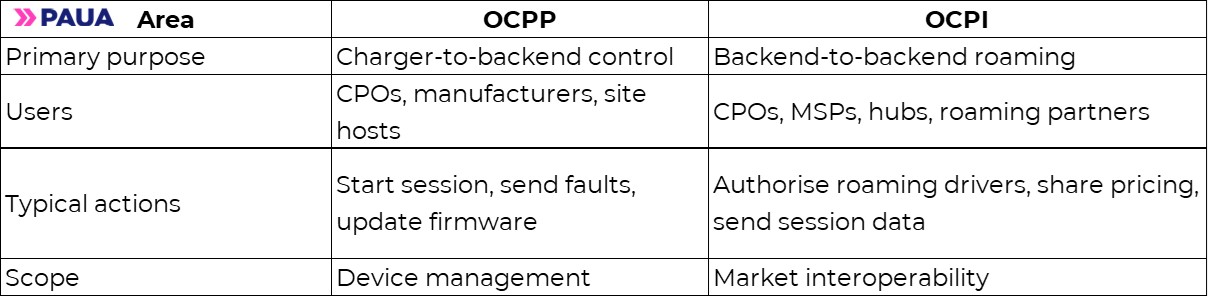
A CPO cannot reliably operate chargers without OCPP. Paua cannot reliably deliver EV charging payment across thousands of connectors without OCPI.
They complement each other beautifully.
What is important about the difference between OCPI and OCPP?
For CPOs integrating with Paua, this is the crucial insight:
- OCPP affects the reliability of individual chargers.
- OCPI affects the experience fleets receive when using your chargers through Paua.
If OCPP performance is poor, your chargers appear unreliable. If OCPI performance is poor, your chargers appear unreachable. Both matter for driver satisfaction and both influence whether fleets return to your network.
OCPI is also where commercial models come to life. Clear tariffs, correct CDRs and transparent status updates ensure that settlement happens quickly, billing is accurate and your chargers remain attractive to large fleet customers.
What do OCPP and OCPI connect?
OCPP connects:
- Charge point
- To the Charge Point Management System (CPMS)
OCPI connects:
- CPMS (CPO backend)
- To MSPs like Paua
- Optional hubs and roaming platforms
If you imagine the national EV charging ecosystem as a series of islands, OCPP keeps each island functioning. OCPI builds the bridges between them.
What jobs do OCPP and OCPI do?
The jobs of OCPP
OCPP spends its days keeping hardware well behaved:
- Health checks
- Heartbeats
- Error notifications
- Local transaction logs
- Firmware distribution
- Real time commands
It is the engineering backbone. Without it, your network falls silent.
The jobs of OCPI
OCPI is the commercial and operational handshake:
- Authenticating a Paua driver at your chargepoint
- Providing session data and CDR's (Charge Detail Records) for invoicing
- Supplying tariffs so Paua can show correct pricing
- Sharing location updates for routing and discovery
- Answering whether a chargepoint is busy, available or offline
OCPI makes roaming work. Paua builds on OCPI to enable fleets to charge anywhere with a single EV charge card, one invoice and unified reporting.
Data flows of OCPI and OCPP in a typical Paua scenario
Let us walk through a standard roaming flow when a Paua fleet driver plugs into one of your chargers:
- OCPP heartbeat: The charger regularly reports its status to your CPMS.
- Paua driver taps to charge: Paua sends an OCPI Authorisation Request to your backend.
- Your backend checks valid access: If the token is accepted, the backend instructs the charger to start via OCPP.
- Charging session runs: Throughout the session the charger sends OCPP meter values and status updates.
- Session ends: Your backend compiles the charging record.
- OCPI CDR submission: The CPO backend sends Paua a charge detail record.
- Paua invoices the fleet and the settlement flow between Paua and the CPO completes.
OCPP and OCPI work in tandem. When both are well implemented, the experience is seamless not only for drivers but also for CPOs and MSPs.
Which is more important to Paua?
Paua’s core mission is to give fleets universal, reliable and fairly priced EV charging payment across the UK. That means:
- OCPI is absolutely central.
It is how we build roaming connections, ingest tariffs, retrieve availability and process millions of pounds of charging payments. - OCPP matters indirectly.
We do not operate OCPP links ourselves but we rely on your OCPP performance. Stable OCPP means healthy chargers which in turn leads to excellent driver experience for fleets using Paua Access.
If you are a CPO, investing in good OCPP infrastructure improves your physical network. Investing in clean OCPI integration with Paua improves your commercial reach.
What about the other standards? OICH, OCSP, ISO 15118 and friends
The EV ecosystem has a lively standards alphabet. A quick tour:
OICH
Open InterCharge Protocol, developed by Hubject. It predates widespread OCPI adoption and is largely used by networks participating in Hubject’s roaming platform. OCPI is now the more broadly adopted open standard, especially in Europe and the UK.
OCSP
Sometimes confused with EV standards. OCSP is actually a certificate checking mechanism used in IT security. It appears around EV when discussing secure communications and certificate validation.
ISO 15118
The “Plug and Charge” and vehicle-to-grid standard. It governs communications between the vehicle and the charger. It sits below OCPP and OCPI in the stack and will increasingly matter for OEM fleets and depot operators.
OCHP
Open Clearing House Protocol. Another roaming protocol, used by clearing houses and some European legacy networks. Like OICH, it is gradually giving way to OCPI.
OpenADR
Not EV specific, but relevant for energy demand response. Some chargepoints support it for grid services, smart charging and peak shaving.
DIN SPEC 70121
Also called "AutoCharge", a German specification that defines the early communication layer for DC fast charging, acting as the predecessor to ISO 15118 and enabling basic vehicle-to-charger messaging before full Plug and Charge capability.
If you are a CPO wondering which one to focus on, the answer is simple:
Get OCPP right for charger reliability and OCPI right for roaming.
What is a CPO, CPMS, EMSP and roaming hub and how do they relate?
CPO (Chargepoint Operator)
Owns or operates the chargers. Responsible for availability, pricing, maintenance and OCPP.
CPMS (Charge Point Management System)
The software a CPO uses to operate their chargers. Handles OCPP messaging, pricing rules, analytics and local access control.
EMSP or MSP (Electric mobility Service Provider)
A roaming or charge card provider like Paua. Offers fleets access to charging across multiple networks and handles billing, reporting and fleet management tools.
Roaming hubs
Platforms that act as intermediaries between multiple CPOs and MSPs. Examples include Hubject or Gireve. Paua integrates directly with many CPOs via OCPI and can also use hubs when beneficial.
The relationships look like this:
- CPO ↔ CPMS via OCPP
- CPMS ↔ MSP (Paua) via OCPI
- MSP ↔ fleets via EV charge cards, apps, APIs and consolidated invoicing
- Hubs allow extra connectivity where needed
This entire stack keeps the UK’s EV charging payment ecosystem functioning at scale for multi-driver fleet customers.
Acronym Buster
A quick guide to the alphabet soup of EV charging. Perfect for bookmarking, sharing or nodding at knowingly in meetings.
API
Application Programming Interface. A structured way for different software systems to talk to each other. Paua uses APIs extensively for fleet tools, billing and integrations.
CPO
Chargepoint Operator. The organisation responsible for operating, maintaining and pricing EV chargepoints.
CPMS
Charge Point Management System. The software platform a CPO uses to run their chargers, manage OCPP traffic, set tariffs and monitor uptime.
CDR
Charge Detail Record. The formal session record sent from a CPO to an MSP. Includes start and end time, energy consumed, pricing components and identifiers used for settlement.
EVSE
Electric Vehicle Supply Equipment. The technical name for the chargepoint hardware. The bit bolted to the ground.
EMSP / MSP
E mobility Service Provider or Mobility Service Provider. A roaming or EV charge card platform like Paua that gives fleets access to many networks in one place.
HGV / eHGV
Heavy Goods Vehicle or electric Heavy Goods Vehicle. Increasingly important in the shift to commercial fleet electrification.
ISO 15118
The communications standard for Plug and Charge and vehicle-to-grid. Enables seamless identification of a vehicle at a charger.
kW
Kilowatt. The unit of power used to measure the speed at which energy moves into your vehicle.
kWh
Kilowatt-hour. The unit of energy used to measure EV charging consumption.
OCPP
Open Charge Point Protocol. The language between a charger and the CPO’s backend system.
OCPI
Open Charge Point Interface. The language between companies. Used for roaming, tariffs, authorisation and settlement.
OCHP
Open Clearing House Protocol. Legacy roaming protocol used by some European clearing houses.
OICH
Open InterCharge Protocol. Hubject’s roaming protocol. Still in circulation but increasingly overtaken by OCPI.
OpenADR
Open Automated Demand Response. Used for flexible energy management and smart charging services.
PaaS
Platform as a Service. Not specific to EVs, but relevant where CPOs or MSPs provide hosted platforms for customers.
RFID
Radio Frequency Identification. The technology behind the cards tags or fobs drivers tap at chargepoints.
Roaming Hub
An intermediary platform that allows many CPOs and MSPs to interconnect through a single integration.
V2G
Vehicle to Grid. Often used in various forms of V2H/B/X to represent the movement of energy from your vehicle out into the grid or home or building or "x= anything".
Why Paua is the network partner of choice for CPOs
Paua is committed to making roaming simple for CPOs and seamless for fleets. A few reasons CPOs choose to integrate with us:
- We bring high value fleet traffic.
Our customers represent some of the UK’s largest multi-driver fleets across vans, company cars and eHGVs. - We maintain one of the UK’s largest aggregated EV charging network across public rapid charging, private depots, destination sites and heavy goods locations.
- Our OCPI integrations are fast, clean and efficient so you spend less time untangling technical issues and more time growing throughput.
- We help fleets transition to zero emission vehicles by offering a simple EV charge card, universal access, home charging reimbursement and enterprise grade APIs.
- We champion data quality.
Good tariffs, precise location information and accurate session data all improve driver trust and your revenue.
When OCPI and OCPP both shine, fleets love your network. Paua helps make that happen.
Paua is a business EV charging payment platform that enables fleets to manage public, home and workplace charging in one system. Paua.com