Tax and Home EV Charging Reimbursement
A practical guide for fleets and payroll teams
This guide explains current HMRC guidance. It is not tax advice.
About this guide
Electric vehicle home charging reimbursement sits at the intersection of tax, payroll and energy policy. For company car electric vehicles, reimbursement of electricity used for business mileage can be made without creating a taxable benefit, provided it is structured correctly under HMRC guidance.
On this page, we explore how electricity is treated for benefit in kind purposes, how the Advisory Electric Rate applies to company cars, where Approved Mileage Allowance Payments apply to employee owned vehicles, and what evidence employers need to support tax compliant reimbursement.
This guide is for information only and does not constitute tax advice.
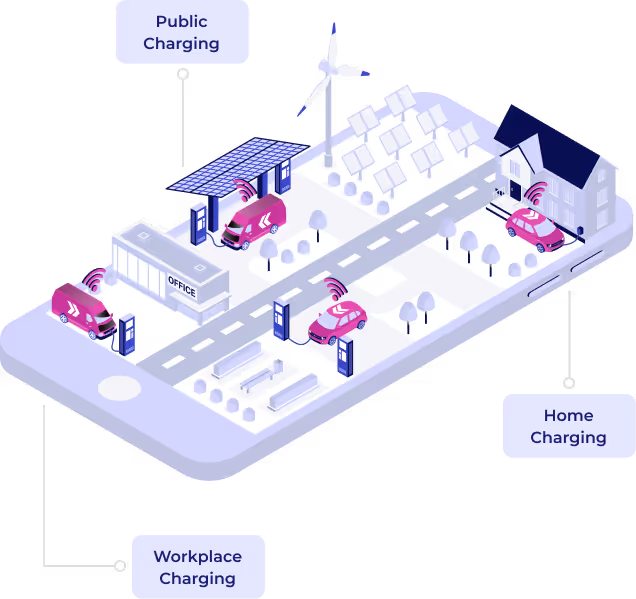
Electric vehicle charging at home represents a key approach to electrification of your fleet.
Is electricity treated as fuel for tax?
- No.
- HMRC does not treat electricity as fuel for benefit in kind fuel charge purposes.
That means:
- Charging a company EV does not trigger the traditional fuel benefit charge
- Reimbursing electricity for charging a company EV does not automatically create a taxable benefit
This is a foundational difference from petrol and diesel company cars.
Can employers reimburse home charging tax free?
Yes, in most structured scenarios where the right evidence is provided.
- The vehicle is a company car
- The reimbursement relates to electricity used to charge that vehicle for business use (business mileage needs tracked as evidence)
Then:
- Reimbursement can be made without creating a taxable benefit
The key requirement is that payments must relate specifically to EV charging.
Which brings us neatly to data.
Why data and evidence matter when completing electric vehicle reimbursement
HMRC expects reimbursements to be:
- Justifiable
- Reasonable
- Consistent
You do not need to trace individual electrons. But you do need a defensible methodology.
Evidence can include:
- Smart charger data
- Vehicle telematics
- Energy tariffs
- Mileage logs (ensuring a clear split of private and business miles)
- Advisory rates
If challenged, the question is simple: "Can you explain how you calculated this?"
- If "yes", you are in good territory.
Advisory Electric Rate (AER) explained for business mile reimbursement
The Advisory Electric Rate is HMRC’s published safe harbour rate for reimbursing electricity used for business mileage in company electric cars.
It applies only to:
- Company cars
- Business miles
It does not apply to employee owned vehicles.
HMRC currently publishes two electric rates:
- A rate for drivers who can charge at home
- A rate for drivers who cannot charge at home and rely on public charging
The distinction is based on the driver’s charging access, not on tracing individual charging sessions or allocating specific kWh to specific journeys. This means the same rate will apply to the driver at all times unless they undergo a signifcant change such as moving house or having a home EV charge point installed.
Employers should apply the rate that reflects the driver’s normal charging circumstances and use a reasonable and consistent methodology.
AER provides payroll with a low risk, administratively simple route. However, it is a proxy rate and may not reflect actual electricity costs in every scenario.
Often drivers feel out of pocket. Paua has built a calculator to assess if you or your drivers are out of pocket.
Are you or your drivers out of pocket?
The Advisory Electric Rate is designed to be simple, not precise. In many cases, it does not reflect real world electricity costs, especially with time of use tariffs or public charging.
Paua has built a reimbursement calculator to help you check.
- See if your drivers are being under reimbursed
- Test your position against HMRC AER
- Generate a clear report to share internally
Try the calculator and understand your position:
Because "close enough" is not always good enough when it comes to employee costs.
AMAP explained
Approved Mileage Allowance Payments apply when:

The vehicle is employee owned
Rates are:
The vehicle is 45p per mile for first 10,000 miles
25p thereafter
This covers everything:
Energy
Depreciation
Insurance
Wear and tear
You do not separately reimburse electricity for employee owned vehicles.
AER and AMAP do not overlap. They should be used separately and distinctly dependent on vehicle ownership.
Company car vs. employee owned: the decision point for reimbursement

Everything starts here.
Getting this wrong creates tax risk.
Getting it right simplifies everything else.
Actual cost vs. AER; how to reimburse fairly above AER rates
Now we have identified that AER tends to undercompensate employee's lets look at how we can compensate more fairly. Employers can reimburse:
At AER
At actual cost per kWh
If reimbursing above AER, you must be able to justify actual costs.
For home charging, actual cost requires:
Tariff awareness
Time of use logic
Accurate kWh allocation
This is where many policies fall apart without automation.
Alternatively you can reimburse above AER without evidence but anything above this is treated as income or a benefit in kind and should be grossed up (National Insurance and PAYE income tax needs to be accounted for).
Mixed charging and apportionment of private and business miles
The reality of driving electric vehicles in businesses is messy. They can be charged in many places and for differing reasons (particularly when the vehicle is not used 100% for business).
EVs are charged:

At home
At public chargers
At workplaces
HMRC allows apportionment where business miles are powered by different sources. Private and business miles need tracked to trace this apportionment.
But electrons cannot be traced to specific journeys.
What matters is:
A fair methodology
Consistent application
Sensible documentation
Over engineering this creates friction.
Under evidencing it creates risk.
This is where Paua operates. Our methodologies address this messiness.
Read about the different methods for home reimbursement here.
What about private mileage?
For company cars:
- Private electricity reimbursement does not trigger a fuel benefit but it is an additional benefit and needs managed as such
- But company policies must still be clear
- Paua ensures that reimbursement can be made for business only miles and not private mileage
Some businesses operate:
- AER only reimbursement
- AER plus top up (with appropriate tax treatment)
- Reverse AER models (a higher cost to the business but powerful to move drivers across to EV)
Each has different financial and behavioural impacts.
Tax is only one lens. Policy design is the other. Paua Reimburse is designed to cover both.
How to reimburse; Payroll vs energy bill payment
Reimbursement can be made:
- Via payroll
- Direct to the driver
- As a payment to the energy bill
Each route has operational implications.
Payroll must be aligned with:
- Vehicle status
- Reimbursement method
- Evidence model
Clarity avoids messy P11D surprises and ensures that the tax treatment is right so nothing unexpected lands with payroll at year end.
Common compliance risks
Paua has gathered some of the most common compliance challenges based on our learnings to date.
- Treating employee owned cars as company cars
- Paying above AER without evidence to explain to HMRC why this is valid
- Ignoring tariff variation; as above a validation
- Applying public AER universally even when some drivers should clearly be on the lower home AER rate
- No documented methodology
- Allowing drivers to input their own charging data without oversite; leads to fraudulent claims
Most problems arise from simplicity applied incorrectly.
What good looks like
A defensible home charging reimbursement policy should include:
- Clear vehicle classification; who is the owner?
- Defined reimbursement method (Paua offers five approaches - read more here)
- Evidence capture
- Consistent calculation engine
- Payroll alignment
- Documented rationale
When structured properly, home charging reimbursement is low risk and scalable.
Paua offers five different methods to manage home reimbursement

Learn about those methods here:
Final thought on home EV reimbursement
EV reimbursement is not complex because of tax.
It becomes complex when:
Data is missing
Policy is unclear
Technology is fragmented
The right structure removes most of the anxiety.
Paua provides this through Paua Reimburse
Proud Paua Customers