The definitive FAQ on EV home charging reimbursement for UK businesses
Everything fleets need to know about home EV charging and reimbursement and how Paua helps.
HMRC rules, reimbursement methods, risks and best practice explained clearly
Home charging for business vehicles
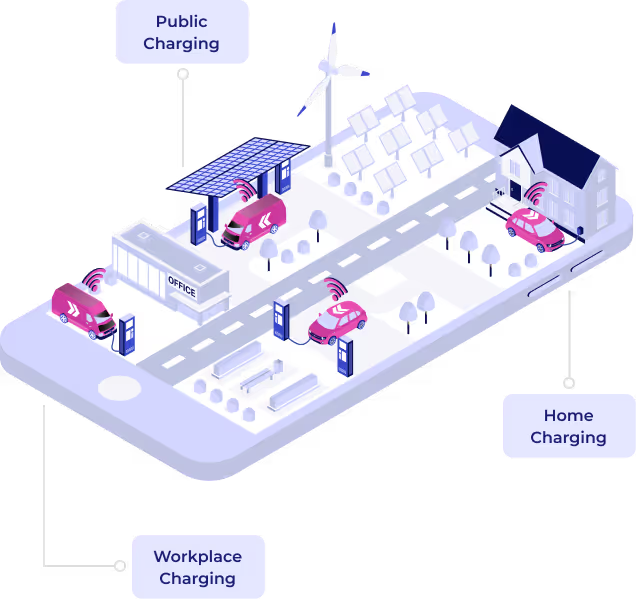
Home charging is now one of the most important building blocks of electric fleet adoption. For many fleets, it is not a “nice to have” but the default charging behaviour for drivers. It is cheaper, more convenient and easier to scale than relying solely on public or workplace infrastructure.
But while home charging is simple for the driver, it introduces a set of financial, operational and fairness challenges for businesses that are easy to underestimate. Understanding these challenges is the first step towards managing them properly.
This page sets the foundation. What home charging for business vehicles really means, why fleets encourage it, where the costs sit, and why reimbursement becomes unavoidable as fleets grow.
Paua Reimburse is our solution to manage home energy reimbursement for electric fleets.
HMRC, tax and audit


It can be tax-free if the reimbursement relates only to business travel and is calculated using a reasonable, auditable method. Any personal benefit must be excluded or correctly taxed.
HMRC expects evidence such as mileage records, business trip classifications, charging data or calculations, approval logs and clear policy controls.
Commuting is generally treated as personal use. Charging that relates to commuting is therefore not tax-free and should be excluded from business reimbursement calculations. Please take tax advice to get this correct for your business.
Yes. Any reimbursement above HMRC-approved limits, or any personal charging reimbursed by the business, may be treated as a Benefit in Kind. The key is to ensure records are kept of actual costs above the Advisory Electricity Rate (AER) shoudl you take this approach
Over-reimbursement can create tax risk, including BiK exposure and potential HMRC challenge during an audit. Keep records.
Employers should retain records in line with standard HMRC guidance, typically at least six years.
HMRC may request evidence showing how reimbursement amounts were calculated, how business use was identified, and how personal use was excluded.
Yes. Different employees can be reimbursed using different HMRC-compliant methods depending on their charging setup and role.
Yes. The principles are similar, but ownership, usage rules and tax treatment can differ and should be reflected in policy.
Importantly private cars may be reimbursed on the AMAP (Approved Mileage Allowance Payments) rate.
Business vs Private use
By identifying business mileage, applying commuting rules and reimbursing only the business-related portion of energy or miles.
Business trips are recorded and can be reviewed and approved by line managers or finance teams depending on company policy.
Missing trips can delay or reduce reimbursement. Clear processes and approvals help prevent errors and disputes.
Yes. Line manager approval adds governance and creates a clear audit trail for HMRC purposes.
Where required, personal charging can be reconciled and recovered via payroll deduction or direct payment.
Only the business portion is reimbursed. Higher personal use reduces the reimbursable amount.
Mixed-use vehicles are supported by explicitly separating business, commuting and personal travel.
Through approved mileage, clear policies, validation rules and audit-ready records.
Home charging hardware and setup
No. Smart chargers help with accuracy, but alternative reimbursement methods can be used if data is unavailable.
Yes, although this limits the data available and may require estimated reimbursement methods. Please also review the safety of charging in this way as it is not generally reccomended.
Alternative methods such as vehicle efficiency or mileage-based reimbursement can be used instead.
Yes, but accurate attribution requires good data and clear processes.
Home details and tariffs can be updated so reimbursement reflects the new situation.
Reimbursement methods must ensure only business-related charging is reimbursed. With the correct data this can be managed.
No. Separate meters are rare and usually unnecessary. They generally add additional costs.
Drivers may rely more on public or workplace charging, which should be reflected in reimbursement policy.
Energy tariffs and costs
Yes, when charging data and tariff information are available.
Dynamic tariffs can be reflected accurately when data allows. Otherwise, sensible averages are applied.
Reimbursement calculations can reflect tariff changes within the claim period.
Overnight charging is treated like any other charging session, based on the applicable tariff at the time.
Yes, where tariff data supports it. This may need accurate home energy data to support this. Otherwise sensible averages are appplied.
Tariff details are updated so reimbursement remains accurate. Drivers are reminded to update tariffs.
Estimates are more accurate than flat rates but less precise than real charging data.
Public vs Home charging
Yes. Many drivers use a combination of both.
Higher public charging costs are reflected where the business is responsible for those charges.
Public charging can be paid directly by the business or reimbursed via receipts, depending on setup.
Yes, for example via a charging card.
Reimbursement methods can be adjusted to suit public-charging-heavy use cases.
Yes. Different methods can apply depending on where and how charging occurs.
Operations, payroll and payments
Common methods include payroll, bank transfer or direct toenergy bill reimbursement.
Yes. Payroll is commonly used.
Yes, where required, via payroll deduction or direct payment.
Claim frequency is defined by employer policy, often monthly.
Yes. Approval workflows can be applied before payment is made.
Claims can be queried, corrected and reprocessed.
Yes, subject to policy controls. Generally not recomended.
Clear data, transparency and line manager approval for records help resolve disputes quickly.
Scaling and fleet maturity
Yes. Manual processes break down as fleet size increases.
Yes, provided reimbursement is systemised and policy-driven.
Yes. Policies can vary by role, vehicle or usage pattern.
Through configurable rules, approvals and manual review where needed. Every driver can be set on a separate method.
Yes. Reimbursement methods and rates can be updated as fleets mature.
Systems-based reimbursement allows scaling without adding admin burden.
Comparison
No. Paying the bill does not prove business use or exclude personal benefit.
Because charging costs vary by tariff, location and behaviour.
Not all chargers expose reliable data and not all drivers have supported hardware.
Fallback methods such as vehicle efficiency or mileage rates are used.
Because energy is paid via personal bills and vehicles are often mixed-use.
Tax exposure, overpayment, underpayment, disputes and HMRC challenge.
Driver experience
They should not be if reimbursement is accurate and timely.
Transparency and clear explanations are critical to trust.
Drivers can see how reimbursement amounts are calculated.
Yes, including mileage, tariffs and splits where applicable.
Support is available via employer contacts and Paua support channels.
This content is provided for general information only and does not constitute tax or legal advice. Tax treatment may vary depending on individual circumstances and HMRC guidance.
Proud Paua Customers







How businesses manage home charging reimbursement at scale
Home charging works brilliantly for drivers.
It becomes harder for businesses when reimbursement needs to be accurate, fair, compliant and scalable.This is where purpose built infrastructure matters.
Paua Reimburse helps fleets manage home energy reimbursement properly by:
It removes manual effort, reduces disputes and supports EV adoption without creating admin drag.
- Calculating the true cost of home charging
- Separating business and personal energy use
- Supporting different tariffs and driver types
- Giving finance teams confidence and control
- Paying drivers accurately and on time